You have written a children's book. The manuscript sits finished on your screen, and a single question hangs over it: what now? For most first-time authors the path from a Word document to a real book on a shelf feels like a closed door with no handle. It is not. The process is clear, and once you can see the whole road it stops being frightening.
This is the full journey of publishing your first children's book, explained in plain language, with no jargon and no surprises. We will walk the stages in order, compare your options honestly, show how you can keep 100% of your royalties, and flag the mistakes that trip up first-timers most often.
Before you begin: what "ready" actually means
Many authors rush to publish a draft that needs one more pass. A manuscript is ready when it reads smoothly out loud, every page earns its place, and a child you have read it to asks for it again. If you are not there yet, that is normal, and it is exactly what the editing stage is for. The worst thing you can do is treat a first draft as a finished book.
From manuscript to printed book: the key stages
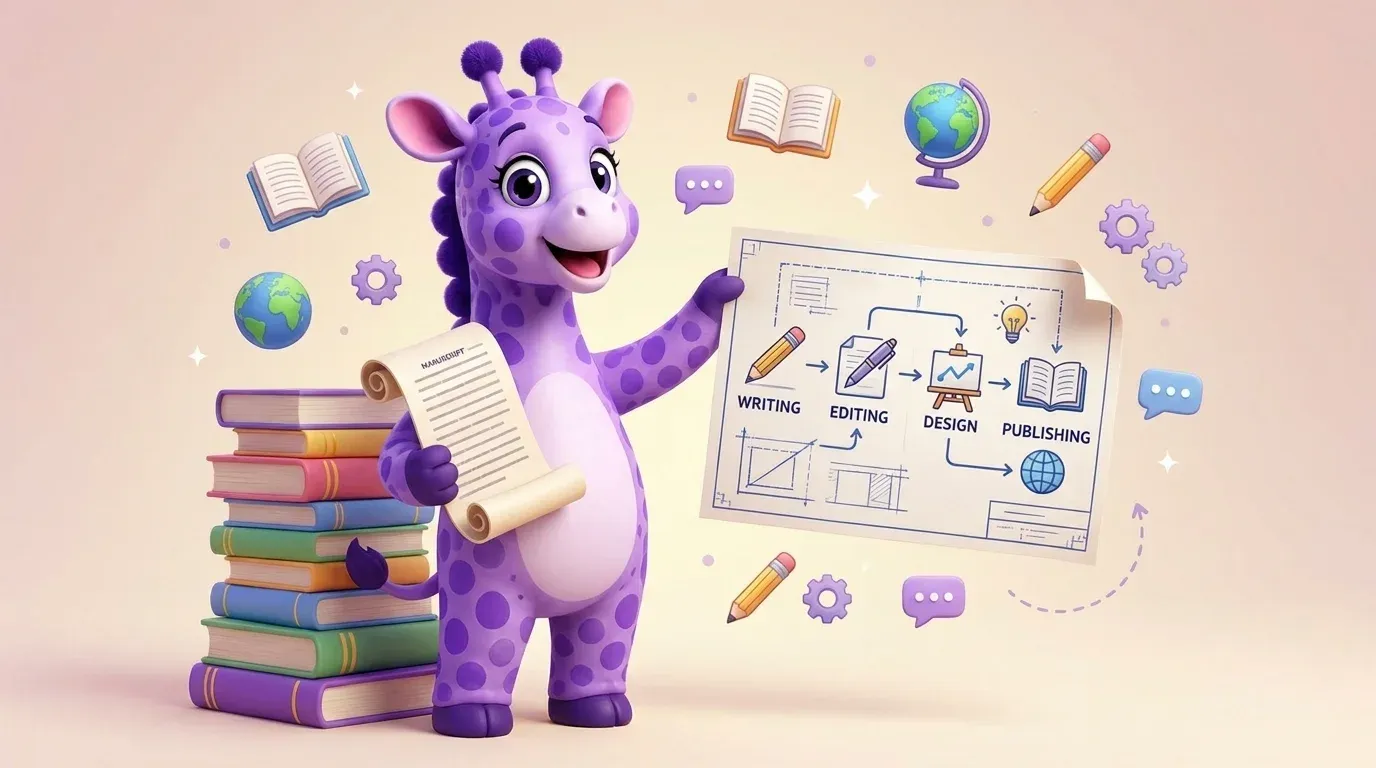
Every children's book, whatever route you take, moves through the same core stages. Here is the journey in order.
- Editorial assessment. A professional reader looks at your whole manuscript and tells you honestly what is working and what is not. This is where you find out if the story is ready or needs another pass.
- Editing. Structural notes shape the story, then line edits polish the words. For picture books this often means cutting, because the pictures will carry what the text no longer needs. Our editors work at every level here.
- Illustration. The right artist is paired to your story and draws the spreads, from rough sketches through to finished art. This is usually the longest and most exciting stage. Our illustration team handles the full process.
- Design and typesetting. Words and art are laid out across the spreads, the cover is designed, and the whole book is set so it reads beautifully on the page.
- Proofreading. A final, fresh pair of eyes catches the small errors that everyone else has stopped seeing after months in the manuscript.
- ISBN and registration. Your book gets its unique identifier so shops, libraries and catalogues can find and stock it.
- Printing. The finished files go to press in your chosen format and paper. Our children's book printing covers the formats and finishes that suit young readers.
- Distribution and launch. The book is made available to buy, and you start telling the world about it. Our distribution gets it in front of readers.
You do not have to manage every one of these alone. Working with a publishing partner means the stages connect smoothly instead of you stitching together a dozen separate freelancers.
Your publishing routes, compared honestly
There are three broad ways to publish a children's book, and the right one depends on how much control, speed and ownership matter to you. Here is the plain comparison.
| What to weigh | Traditional publisher | Going it alone | Purple Giraffe Press |
|---|---|---|---|
| Getting accepted | Very competitive, often needs an agent | Open to anyone | Open, with expert guidance |
| Time to publish | Often two years or more | As fast as you can manage it | Typically months, not years |
| Creative control | Largely with the publisher | Entirely yours | Yours, with a team beside you |
| Royalties | A small percentage to you | You keep the income, but do all the work | You keep 100% of royalties |
| Who does the work | The publisher's team | You hire and manage everyone | Our team, coordinated for you |
| Ownership of your book | Often signed over to the publisher | Yours | Stays fully yours |
How Purple Giraffe Press lets you keep 100% of your royalties
This is the part that surprises authors most. In the traditional model, a publisher takes on the cost and risk, and in return keeps the rights and most of the money, paying you a modest royalty for years. Our model works the other way around. You pay for the publishing services you choose, your book stays yours, and you keep 100% of the royalties on every copy sold.
In practice that means the success of your book benefits you, not a corporation's balance sheet. You are not signing away the rights to your characters, and you are not waiting on a twice-yearly statement to see a fraction of each sale. You own the book, you own the art, and you own the income.
What you are actually paying for
It helps to think of it as hiring a skilled team rather than selling your story. The fee covers editing, illustration, design, print setup and the coordination that holds it all together. Once that work is done, the book and its earnings are yours. You can see how the pieces are priced on our pricing page.
Tips for first-time authors to avoid common mistakes
Most first-book regrets come from a small set of avoidable errors. Sidestep these and you are already ahead.
- Publishing the first draft. Give the story a proper edit. The gap between a draft and a finished book is wide, and readers feel it.
- Hiring your own illustrator before the words are ready. Lock the text first, or you will pay to redraw spreads when the story changes.
- Skipping the proofread. A single typo on a children's page is the thing a sharp-eyed parent will always spot.
- Signing away the rights. Read any contract that asks you to hand over ownership of your book. Keeping your rights keeps your options open.
- Treating the launch as the finish line. Publishing is the start of a book's life, not the end. Plan a little marketing from day one.
A word from our editorial team
We asked the editors who guide first-time authors what they wish every new writer knew.
The authors who enjoy the journey are the ones who let each stage do its job. Edit before you illustrate. Proof before you print. Nobody publishes a perfect book alone on the first try, and you do not have to. Lean on the people who have done it before.
The Editorial Team, Purple Giraffe Press
How long does the whole journey take?
From a polished manuscript, a first children's book usually reaches print in four to eight months. Editing and illustration take the most time, and a few weeks of review sit between each stage. It is faster than the traditional route by a wide margin, and the schedule is something we plan with you up front so there are no surprises. For external community and craft support along the way, first-time authors often find the Society of Children's Book Writers and Illustrators a useful place to keep learning.
Your first book is closer than it looks
Publishing a children's book is not a locked door. It is a sequence of clear, manageable stages, and at the end of them is a real book with your name on the cover. Get the manuscript right, choose a route that lets you keep your rights and your royalties, avoid the handful of common mistakes, and the journey becomes something to enjoy rather than fear. When you are ready to begin, we would love to hear about your story. You might also enjoy our look at why every story deserves a custom illustration as you think about the art ahead.
Ready when you are
Let's bring your children's book to life.
From a first idea to a finished book children adore, we are with you at every step. Tell us about your story and we'll reply within one business day.
Start Publishing →